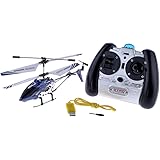
The intricate world of flight has always captivated human imagination, pushing the boundaries of engineering and design. On one side, we observe the robust, mechanically complex helicopter, capable of agile maneuvers and heavy lifting. Conversely, the more recent quadcopter, with its seemingly simple four propellers, relies heavily on electronic sophistication for stable flight. This contrast highlights a fascinating area of innovation: bridging the mechanical simplicity of a drone with the unique control capabilities of a helicopter. The video above beautifully illustrates one such groundbreaking attempt to create a drone helicopter hybrid, aiming to achieve complex aerial control through remarkably simplified mechanics.
Traditional helicopters utilize an adjustable rotor head, often incorporating a swashplate mechanism, alongside a tail rotor for yaw control. This setup allows for precise manipulation of blade angles, granting the aircraft its characteristic agility and ability to hover. Quadcopters, however, achieve stability and movement by precisely altering the speed of their individual fixed-pitch rotors, managed by advanced electronic flight controllers. The project featured in the video explores a novel approach where the mechanical complexity of a helicopter is dramatically reduced, bringing it closer to the lean design of a drone while retaining core helicopter flight principles.
The Genesis of a Mechanically Simple Helicopter Control
The inspiration for this remarkable project stemmed from research conducted by Jimmy Paulos in Professor Mark Yim’s Modlab at the University of Pennsylvania. Their initial aerial vehicle demonstrated an astonishing level of control using only two counter-rotating propellers. This innovative design bypassed the need for additional servos or solenoids, elements commonly found in traditional helicopter rotor heads. Instead, control was achieved through a clever integration of a simple hinged rotor head and an exceptionally precise motor control system. This pioneering work laid the foundation for the drone helicopter hybrid envisioned by the video’s creator.
The core innovation lies in how the rotor blades react to changes in motor speed. As the speed of the motor is increased or decreased, the blades naturally lag or lead, altering their angle of attack. This dynamic movement, governed by the motor’s speed, essentially emulates the cyclic pitch control found in a much more complex helicopter rotor head. It is quite astounding that such sophisticated control can be derived from the precise modulation of a single motor’s rotational velocity. This concept greatly simplifies the mechanical architecture, aligning with the drone’s minimalist design philosophy.
Unpacking the Virtual Swashplate Concept
In a conventional helicopter, the swashplate is a critical component that translates pilot inputs into changes in the rotor blades’ pitch. Pushing the cyclic stick forward, for instance, tilts the swashplate, which then adjusts the pitch of the blades at specific points in their rotation, ultimately causing the helicopter to move forward. This intricate mechanical system precisely dictates the angle of the main rotor blades. However, the drone helicopter hybrid described in the video adopts a different, more streamlined strategy, effectively employing a “virtual swashplate.”
This virtual swashplate operates entirely through software and precise motor control rather than physical components. When the motor’s speed is sinusoidally varied throughout each rotation, it causes the blades to lead and lag at specific points. This controlled oscillation of speed and blade position mimics the cyclic pitch adjustments that a physical swashplate would provide. For example, if the motor accelerates during the first 180 degrees of a rotation and decelerates during the next 180 degrees, it creates a specific aerodynamic effect. This effect then generates the desired pitch and roll commands, all without any moving parts beyond the rotor itself.
The Role of Gyroscopic Precession in Flight Control
Understanding gyroscopic precession is vital when discussing helicopter flight, especially with a virtual swashplate. A spinning object, like a helicopter rotor, exhibits gyroscopic properties, meaning it resists changes to its axis of rotation. When a force is applied to a spinning rotor, the resulting effect does not occur at the point of application but rather approximately 90 degrees later in the direction of rotation. This phenomenon is why a conventional swashplate is designed to change blade pitch 90 degrees ahead of the desired movement.
For the drone helicopter hybrid, this principle is crucial. The software-controlled motor speed variations must account for gyroscopic precession. If the pilot wishes the helicopter to tilt forward, the motor’s speed adjustments are timed to affect the blades 90 degrees before the desired forward tilt. This ensures that the aerodynamic forces generated by the virtual swashplate align correctly with the physical properties of the spinning rotor, translating software commands into tangible flight maneuvers. Without properly compensating for precession, the helicopter would simply not respond as expected.
Drone Helicopter Hybrid Design and Challenges
The construction of this experimental aerial vehicle involved several key components and numerous iterative design steps. A brushless drone motor was selected for its power and efficiency, and a diametric magnet was attached to its shaft. Diametric magnetization, where the magnet is polarized across its diameter rather than its faces, is essential for accurate positional sensing. This setup allowed for the close mounting of a magnetic encoder, a device crucial for precisely measuring the motor’s exact angle and, subsequently, its speed at any given moment.
The motor needed to accelerate and decelerate at least twice per rotation to achieve the desired helicopter-like control. This involved writing custom code that applied a sinusoidal wave to the throttle signal, effectively modulating the motor’s speed by 75% with each revolution. Operating at speeds up to 2,000 RPM, which means one rotation takes only 33 milliseconds, this precise control cannot be achieved manually. Such rapid and accurate speed changes, where the motor goes from near standstill to almost 4,000 RPM within a single rotation, are critical for the virtual swashplate’s effectiveness.
Overcoming Mechanical Hurdles in Rotor Head Design
Initial attempts to build the rotor head with angled hinges faced significant challenges. When the blades spun at high RPM, the centrifugal force created by their outward motion generated immense friction at the hinges. This friction was so substantial that the blades simply refused to pivot as intended, preventing any significant pitch changes throughout their rotation. Such an issue highlighted the complex interplay between mechanical design, material properties, and aerodynamic forces in high-speed rotational systems.
Several redesigns of the rotor head were necessary to mitigate this problem. The focus shifted to optimizing the hinge mechanism to minimize friction while maintaining structural integrity under high centrifugal loads. Careful consideration was given to materials, bearing surfaces, and the overall geometry of the hinged components. This iterative process of design, testing, and refinement is a cornerstone of engineering, transforming initial setbacks into opportunities for innovative solutions. Each modification brought the prototype closer to achieving the desired blade articulation and pitch control.
The final structure of the helicopter was crafted from lightweight carbon fiber, chosen specifically to minimize overall weight and reduce the load on the motor. Carbon fiber is known for its excellent strength-to-weight ratio, which is critical for aerial vehicles. The frame parts were then 3D printed, allowing for custom shapes and precise integration of components. Despite having only two motors (the main rotor and a small tail motor for yaw control), the helicopter required careful integration of numerous electronic components, underscoring the electronic complexity required to compensate for mechanical simplicity.
Merging Flight Paths: Your Drone Helicopter Hybrid Q&A
What is a Drone Helicopter Hybrid?
A Drone Helicopter Hybrid is an innovative aircraft designed to combine the mechanical simplicity of a drone with the agile flight control capabilities of a traditional helicopter. It aims to achieve complex aerial maneuvers using fewer mechanical components.
How does this hybrid design simplify a helicopter?
Unlike traditional helicopters that use complex mechanical parts like a swashplate, the hybrid design greatly reduces these physical components. It achieves flight control primarily through advanced software and extremely precise motor speed adjustments.
What is a ‘virtual swashplate’?
A ‘virtual swashplate’ is a software-controlled system that manipulates a helicopter’s rotor blades by rapidly changing the motor’s speed throughout each rotation. This precise, timed oscillation of speed mimics the blade pitch adjustments that a physical swashplate would provide.
Why is gyroscopic precession important for the Drone Helicopter Hybrid?
Gyroscopic precession means that when a force is applied to a spinning rotor, the resulting effect happens about 90 degrees later in the direction of rotation. For the hybrid, its control software must account for this by timing motor speed changes ahead of the desired movement to ensure correct flight response.