Unlocking the Secrets of Drone Flight: Basic Physics Explained
Drones have soared into popular imagination, becoming indispensable tools across a myriad of sectors, from breathtaking aerial photography in entertainment to critical surveillance in military operations and precision agriculture. These unmanned aerial vehicles (UAVs) have revolutionized how we interact with the skies. While their capabilities seem almost magical, the underlying principles of how drones fly and maneuver are firmly rooted in basic physics. If you’ve just watched the video above, you now have a foundational understanding of these concepts.
However, truly appreciating the engineering marvel of these devices requires a deeper dive into the ‘how’ and ‘why.’ Many wonder how these compact machines defy gravity and navigate with such precision. This guide will expand on the video’s insights, breaking down the fundamental physics that govern drone flight, particularly focusing on the widely popular quadcopter design, and explaining the mechanics behind its incredible agility in simple, accessible terms.
The Quadcopter: A Masterclass in Propeller Power
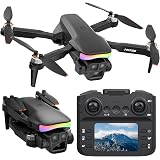
The term “quadcopter” itself offers a clue to its design: “quad” meaning four, referring to the four motors and propellers that are its heart and soul. These aren’t just any propellers; they are precision-engineered blades designed to interact with air in specific ways. Each propeller works like a tiny fan, rapidly pushing air downwards. This action creates a reaction, generating the crucial upward force known as thrust. But how exactly does this translate into sustained flight?
The principle at play here is a cornerstone of classical mechanics: Newton’s Third Law of Motion. This law states that for every action, there is an equal and opposite reaction. When a quadcopter’s propellers spin, they push a significant volume of air downwards. The air, in turn, exerts an equal and opposite force back upwards onto the propellers, lifting the entire drone. For the drone to lift off the ground, this combined upward thrust from all four propellers must exceed the drone’s total weight. If the thrust is insufficient, the drone remains grounded. If it’s too great, the drone will ascend rapidly, potentially losing control.
Balancing Act: The Role of Propeller Direction
Achieving lift is just the first step. Preventing the drone from spinning uncontrollably in mid-air is equally vital. Imagine trying to drive a car with a constantly swiveling steering wheel – it’s impossible to maintain a straight path. This instability in a drone comes from a phenomenon called torque.
Every time a propeller spins, it creates a rotational force, or torque, on the motor and thus on the drone’s body. If all four propellers were to spin in the same direction, say clockwise, the cumulative torque would cause the drone’s body to spin uncontrollably in the opposite direction (counterclockwise). To counteract this, quadcopters employ a clever design: two propellers spin clockwise, and the other two spin counterclockwise. These opposing rotational forces effectively cancel each other out, ensuring the drone remains stable and oriented correctly during flight.
Mastering the Skies: Pitch, Roll, and Yaw
Once airborne, a drone doesn’t just hover; it moves with surprising grace and precision. This maneuverability is achieved through three fundamental rotational movements, known in aviation as pitch, roll, and yaw. These movements allow the drone to tilt and turn in any direction, making complex aerial acrobatics or steady, precise movements possible. Understanding these three axes of rotation is key to grasping how drones are controlled.
Pitch: Tilting Forward and Backward
Pitch refers to the rotational movement around the drone’s lateral (side-to-side) axis, often called the Y-axis. When a drone pitches, its nose tilts either down (forward) or up (backward). To initiate a forward pitch, the quadcopter’s flight controller subtly reduces the speed of the front two propellers while simultaneously increasing the speed of the rear two. This creates an imbalance in thrust: less lift at the front, more lift at the rear.
The result is a controlled forward tilt. As the drone tilts, the overall upward thrust from its propellers is no longer purely vertical. Instead, it gains a forward component. This vectoring of thrust is what propels the drone forward through the air. Conversely, to move backward, the rear propellers slow down, and the front propellers speed up, causing a backward tilt and backward motion.
Roll: Tilting Side to Side
Similar to pitch, roll describes the rotational movement around the drone’s longitudinal (front-to-back) axis, or the X-axis. When a drone rolls, it tilts sideways, either to the left or to the right. To achieve a roll to the right, for example, the propellers on the right side of the drone will slightly decrease their speed, while those on the left side will increase theirs. This creates an imbalance, reducing lift on the right and increasing it on the left.
This differential thrust causes the drone to tilt to the right. Just like with pitch, this sideways tilt redirects a portion of the total thrust, pulling the drone laterally through the air. Rolling to the left follows the exact opposite principle, with the left-side propellers reducing speed and the right-side propellers increasing theirs.
Yaw: Changing Facing Direction
Yaw is perhaps the most unique of the three rotational movements. Unlike pitch and roll, which involve tilting the drone to move it horizontally, yaw allows the drone to rotate on its vertical axis (the Z-axis). This movement changes the direction the drone is facing without necessarily moving it sideways or forward. Imagine a spinning top; that’s yaw.
The secret to yaw control lies in temporarily unbalancing the carefully calibrated opposing torques. As discussed, two propellers spin clockwise, and two spin counterclockwise to maintain stability. To make the drone yaw, the flight controller intentionally alters the speed relationship between these opposing pairs. For example, to make the drone turn clockwise (yaw right), the counter-clockwise spinning propellers might be slightly sped up, while the clockwise spinning propellers are slightly slowed down. This creates a temporary net torque in the desired direction, causing the drone to rotate. Once the desired orientation is achieved, the propeller speeds are re-balanced to cancel torque again, maintaining the new heading.
The Brain Behind the Blades: Flight Controllers and Sensors
While the physics principles of thrust, torque, pitch, roll, and yaw explain the mechanics, the actual execution of these movements is managed by sophisticated onboard technology. Every modern quadcopter relies on a complex “flight controller” – essentially a miniature computer that acts as the drone’s brain. This controller continuously processes data from various sensors, including gyroscopes and accelerometers, which detect the drone’s orientation, tilt, and movement in real-time.
When a pilot inputs a command via a remote control, the flight controller interprets this command (e.g., “move forward”). It then instantaneously calculates the precise adjustments needed for each of the four motors’ speeds to achieve the desired pitch, roll, or yaw. This constant feedback loop and rapid calculation are what allow drones to maintain stability and execute intricate maneuvers with such fluidity. Without this intricate interplay of physics and intelligent control systems, the precise flight of a quadcopter would be impossible.
Soaring Through Your Drone Flight Physics Queries
What is a quadcopter?
A quadcopter is a type of drone that has four motors and propellers. These four propellers are essential for its flight and movement.
How does a drone lift off the ground?
Drones lift off by spinning their propellers, which push air downwards. This creates an equal and opposite upward force called thrust, lifting the drone.
Why doesn’t a quadcopter spin uncontrollably in the air?
Quadcopter propellers spin in opposing directions (two clockwise, two counterclockwise) to cancel out rotational forces, keeping the drone stable and preventing it from spinning.
How does a drone move forward or backward?
Drones move forward or backward by tilting their body, known as pitch. They achieve this by slightly adjusting the speed of the front or rear propellers, which redirects the thrust.
How does a drone turn to face a different direction while hovering?
A drone changes its facing direction, or yaws, by subtly altering the speed relationship between its opposing pairs of propellers. This creates a temporary imbalance in rotational forces, causing the drone to turn.