The first time you see a modern drone gracefully navigate the skies, performing intricate maneuvers with seemingly effortless precision, it’s hard not to feel a sense of wonder. These flying machines have evolved from rudimentary toys into sophisticated aerial platforms, capable of everything from delivering packages to capturing cinematic footage. But have you ever paused to consider the intricate dance of engineering that allows these devices to defy gravity and respond to your commands? The video above offers a fantastic primer on the inner workings of these aerial marvels, and we’re here to dive even deeper into the mechanical design aspects, electronic controllers, advanced sensors, and intelligent algorithms that power today’s drones.
Understanding how drones operate involves appreciating a symphony of interconnected systems. From the fundamental physics of lift to the complex computations happening milliseconds at a time, every component plays a crucial role in bringing these sophisticated devices to life. Let’s unpack the core principles and cutting-edge technologies that enable drones to become such perfect flying machines.
Propeller Power: The Evolution of Drone Design
At the heart of any flying machine is the ability to generate lift. For drones, this comes down to propellers. The journey from a primitive drone to the sleek, efficient quadcopters we see today is a story of overcoming fundamental engineering challenges, particularly around control and stability.
From Simple Lift to Complex Control: Propeller Configurations
Initially, a single propeller design provides enough thrust to get off the ground. However, as the video highlights, this offers no practical control beyond vertical movement. Moreover, Newton’s third law of motion dictates that for every action, there’s an equal and opposite reaction. When the propeller spins one way, the drone body wants to spin the other, leading to an uncontrollable rotation.
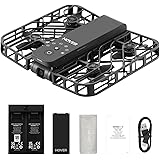
This challenge led engineers to consider multiple propellers. A two-propeller design, for instance, can theoretically cancel out the reaction torque by having blades spin in opposite directions. Companies like Zero Zero Robotics have explored this concept, recognizing that fewer propellers mean less energy consumption and longer flight times. Yet, the main hurdle for dual-propeller drones remains stability and control accuracy, especially when performing high-speed maneuvers or sharp turns. Achieving the necessary degree of agility with just two points of thrust demands exceptionally advanced control algorithms that are still under development.
Three-propeller designs, while possible, are rarely seen in consumer or industrial drones. The inherent issues with managing motor reaction torque and gyroscopic precession in a three-point system introduce unnecessary design complications and algorithmic complexities, making them less practical compared to their four-propeller counterparts.
The Aerodynamics of Flight: How Quadcopters Soar
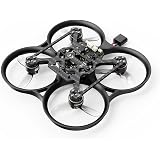
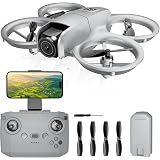
The quadcopter, characterized by its four propellers, usually arranged in an H-shape or X-shape, has become the most prevalent and stable drone design. Its popularity stems from its inherent stability and the precise control it offers through subtle manipulations of propeller speeds. Each propeller utilizes an airfoil shape, expertly designed to generate lift force efficiently as it slices through the air.
Mastering Maneuvers: Hovering, Pitch, Roll, and Yaw
Understanding how quadcopters perform maneuvers is key to appreciating their intelligence:
-
Hovering: This is the simplest state, achieved when the total thrust produced by all four propellers precisely balances the drone’s weight. All propellers spin at the same speed, maintaining a stable position in the air.
-
Forward/Backward Motion (Pitch): To move forward, the flight controller slightly decreases the speed of the front propellers and increases the speed of the rear ones. This creates an imbalance, tilting the drone’s nose down. The resultant horizontal component of the lift force then propels the drone forward. The reverse action achieves backward movement.
-
Sideways Motion (Roll): Similar to pitch, roll is achieved by creating a lift imbalance between the left and right pairs of propellers. Increasing the speed of propellers on one side while decreasing it on the other causes the drone to tilt, generating a sideways thrust.
-
Turning (Yaw): This is where quadcopters brilliantly manage the reaction torque. In stable flight, diagonal pairs of propellers spin in opposite directions. For example, propellers 1 and 3 might spin clockwise, while 2 and 4 spin counter-clockwise. This setup perfectly cancels out the motor’s reaction torques, preventing unwanted rotation. To yaw the drone, the flight controller slightly alters the speeds of one diagonal pair relative to the other. For instance, reducing the speed of the clockwise-spinning pair while increasing the counter-clockwise pair’s speed will result in a net reaction torque, causing the drone to rotate horizontally on its axis. This ingenious method ensures precise rotational control.
The ability to precisely control each of these motions, often simultaneously, makes quadcopters incredibly versatile and stable platforms, suitable for a vast array of applications across almost every industry.
The Drone’s Nervous System: Flight Controllers and Sensors
While mechanical design lays the foundation, the true intelligence of a modern drone lies in its sophisticated electronic systems. Imagine a drone caught in a sudden gust of wind. A human operator would struggle to manually adjust four individual propeller speeds and directions in milliseconds to prevent a crash. This is where the drone’s “brain” — the flight controller — takes over.
The Intelligent Pilot: Flight Controllers
The flight controller acts as a tiny, intelligent pilot, constantly processing data and making real-time adjustments. It translates simple user commands (like “up” or “forward”) into complex sequences of propeller speed changes. This enables an intuitive user experience, making drone operation feel as simple as playing a video game, even though the underlying mechanics are highly intricate.
The World of Drone Sensors: Micro-Scale Precision
To make intelligent decisions, the flight controller relies on a constant stream of input from a network of highly accurate sensors. These sensors are often incredibly tiny, with many comparable in size to an ant, thanks to Micro-Electro-Mechanical Systems (MEMS) technology. MEMS sensors are miniature machines with actual moving parts, capable of remarkable precision despite their minuscule size.
The most critical group of sensors resides within the Inertial Measurement Unit (IMU), often referred to as the “king of drone sensors.” An IMU typically combines three essential components:
-
Accelerometers: These sensors measure linear acceleration along three axes (X, Y, Z). Inside a MEMS accelerometer, as the drone moves, tiny plates shift, altering the capacitance between them. This change in capacitance is converted into an electrical signal, providing crucial data about the drone’s movement.
-
Gyroscopic Sensors (Gyroscopes): These measure angular velocity or rotation along three axes. Paired with accelerometers, they provide comprehensive data on the drone’s orientation and rotational speed, essential for maintaining stability.
-
Magnetometers: Functioning like a digital compass, magnetometers detect the Earth’s magnetic field, providing directional information (heading). This is vital for accurate navigation and maintaining a consistent orientation.
-
Barometer: A MEMS-based barometer measures atmospheric pressure, which the flight controller uses to accurately determine the drone’s altitude. Precise altitude control is paramount for stable flight and avoiding obstacles.
Achieving Accuracy: Sensor Fusion and Algorithms
Raw data from individual sensors can be susceptible to noise and inaccuracies due to factors like manufacturing defects, mechanical vibrations from propellers, or magnetic interference. To overcome these limitations, modern drones employ a technique called sensor fusion.
Beyond Individual Sensors: The Power of Sensor Fusion
Sensor fusion is the process of combining data from multiple sensors to achieve a more accurate and reliable measurement than any single sensor could provide alone. For example, an IMU combined with a GPS sensor can offer basic altitude information. However, integrating radar technology into this fusion can dramatically enhance the accuracy of altitude measurements, providing precise data even in challenging environments. This multi-sensor approach ensures robustness and reliability, vital for safe and stable drone operation.
The Decision-Making Core: Control Logic and Kalman Filter
With accurate sensor data in hand, the flight controller moves to its decision-making phase, guided by sophisticated control logic and algorithms. One of the most prominent of these is the Kalman Filter (KF) algorithm. The Kalman Filter is a powerful mathematical tool that uses a series of measurements observed over time (containing statistical noise and other inaccuracies) to produce estimates of unknown variables that tend to be more precise than those based on a single measurement alone. It “filters” out noise by predicting the drone’s future state based on past and present data, then correcting that prediction with new sensor inputs.
In the context of drones, the Kalman Filter plays a critical role in:
-
Stabilization: Rapidly compensating for external disturbances like wind gusts by precisely adjusting propeller speeds.
-
Navigation: Providing highly accurate state estimation for GPS navigation, enabling features like waypoint flying and “return-to-home.”
-
Error Reduction: Continuously refining the drone’s estimated position, velocity, and orientation.
Ultimately, the same Kalman Filter algorithm, embedded within the drone’s processor (composed of logic gates and transistors), makes smart, real-time decisions to control the speeds of Brushless DC (BLDC) motors. It is this precise, intelligent control of the four BLDC motors that allows a quadcopter to face and overcome challenging environmental conditions, maintaining stable and happy flight.
Power, Communication, and Industry Leaders
A drone’s ability to fly for extended periods and respond to commands hinges on its power source and communication systems.
Fuelling Flight and Staying Connected
The power required by BLDC motors, electronic circuits, antennas, and all those tiny sensors is typically supplied by lightweight yet energy-dense lithium-ion batteries. These batteries offer the best balance of power output and flight duration for most consumer and commercial drones.
Communication between the operator and the drone occurs via common radio frequency (RF) technology. For many consumer drones, this communication range typically spans between one to two kilometers. But what happens if a drone accidentally flies out of this range? Modern drones employ advanced fail-safes. Utilizing a combination of GPS (Global Positioning System) and sometimes even tower-based internet technology, the drone can navigate itself back to a pre-set “home” location. This “Return-to-Home” feature, leveraging the very GPS and Kalman Filter algorithms used for navigation, ensures that a lost drone can safely make its way back, even if direct operator control is lost.
The Market Leaders: DJI and the Competition
In the competitive consumer drone market, companies like DJI have established themselves as leaders. Their success is attributed to sophisticated algorithms, robust designs including dual IMUs for enhanced reliability, and advanced vibration dampening systems that significantly reduce errors in sensor output. DJI’s commitment to refinement and fitness in their drone designs, powered by their advanced flight control algorithms, has given them a substantial market advantage. While companies like Parrot, Autel, and Yuneec offer viable alternatives, they often struggle to match the refined flight experience and sophisticated capabilities offered by DJI’s consumer UAVs, underscoring the critical role that advanced control and processing play in drone performance.
Hovering Over Your Drone Questions
What is a drone?
A drone is a flying machine that has evolved into a sophisticated aerial platform. It is capable of various tasks, from delivering packages to capturing cinematic footage.
How do drones stay in the air?
Drones stay in the air by generating lift, which primarily comes from their propellers. Each propeller has an airfoil shape designed to efficiently create upward force as it spins through the air.
How does a quadcopter move forward, backward, or turn?
Quadcopter drones move by precisely adjusting the speeds of their four propellers. For example, to move forward, the front propellers slow down while the rear ones speed up, tilting the drone.
What is a drone’s flight controller?
The flight controller is like the drone’s ‘brain,’ acting as an intelligent pilot. It constantly processes data and translates simple user commands into complex, real-time adjustments of propeller speeds.
What types of sensors help a drone understand its environment?
Drones use a network of tiny sensors, primarily within the Inertial Measurement Unit (IMU). These include accelerometers for measuring movement, gyroscopes for rotation, magnetometers for direction, and barometers for altitude.